

Understanding language and talking


Understanding of Language
What is it?
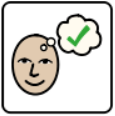
The understanding of language is a complex process. To be able to understand language we need to be able:
· to know what words mean.
· to take meaning from the sentence structure, e.g., “I will post the letter” means something different to “I have posted the letter”.
· to remember the words.
· to interpret the intent of the speaker. This means to be able to understand what is meant rather than what is said, for example, non-literal sayings such as “It’s raining cats and dogs”.
· to use other clues such as gesture and tone of voice.
What to look for.
If your child or young person is finding it hard to understand language you may notice that they:
· look ‘blank’ or appear not to be listening to you.
· seem to forget what you say.
· need time to respond.
· ‘copy’ or ‘echo’ a word(s) you have said.
· respond in ways which are unexpected.
· find it hard to follow instructions
· find it difficult to understand vocabulary.
· need help to understand questions and explanations.
· struggle to follow jokes and/or non-literal sayings e.g. “It’s raining cats and dogs”.
Top Tips
Understanding of language
Make sure you have the child/young person’s attention before speaking to them.
When talking to your child waiting is one of the most powerful things you can do to help your child communicate? Download this leaflet to find out more about waiting and how to use waiting.
If it is a young child, get down to their level (eye level), when talking to them.
Use short sentences.
Give the child/young person time to process what has been said.
Back up what you are saying by using gesture, actions, objects, pictures, and/or demonstration.
Emphasise key words by slightly stressing them.
If it is a multi-step instruction, pause between each step to give the child/young person time to process the step.
Think about the level of language you are using with your child/young person. Download this leaflet which shows the four levels that language can fit in. If your child/young person is finding the language difficult to understand in one level change what you say to the language used in the previous level(s).
Talking
What is it?
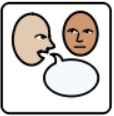
Talking is a form of communication. To use talking we need:
· a reason to communicate.
· to use the correct words
· to put the words into a sentence
· to have the opportunity to communicate.
What to look for.
If a child or young person is finding it difficult to talk you might notice:
In the early days
· they are very quiet and don’t babble much
· they rely more on gesture (e.g., pointing) or other forms of communication (e.g., talking your hand) to let you know what they want.
· take time to learn words and time to put the words together.
Later on
· they find it hard to ‘find’ the right word to express what they mean.
· they use short sentences.
· they have difficulty building full sentences.
· they need help to sequence their ideas to tell a story.
At all stages they may show frustration at not being able to get their message across.
Top Tips.
Talking
Give you child/young person time to say what they want to say.
Look at how they are communicating and model the word they are intending to say. For example, if they are pointing to their cup, you would model “drink”, “you would like a drink”.
Look at what your child is looking at/playing with and model words. For example, if they were playing with a ball you would say “ball”, “blue ball”, “ball gone” etc.
Add an additional word(s) to what your child has said so that you are modelling an extended sentence. For example, if your child/young person said, “I went for a walk”, you could model back “you went for a long walk” or “you went for a walk with mummy”.
Look at books together. Books are a great way to learn new words. Download this leaflet for information about sharing books with your child.
Visit your local library to choose and borrow books. Download this local library information sheet.
Model back your child/young person’s sentence but add or change any words that are needed. For example, if they said, “I catched a fish”, reply with, “yes, you caught a fish”.
Language is learnt best through sharing information rather than asking lots of questions. Take a look at this leaflet which demonstrates this.
More links and leaflets
Speech and Language UK 'talking with your toddler' webinars are free. They are for parents of children aged 12 months to 4 years who are concerned about their child’s talking and understanding of words.
Afasic
Speech and Language UK
Best start in life
Tiny Happy People
National Literacy Trust
The Time together booklet for parents, from the National Literacy Trust, comes in 22 different languages. It is full of suggestions for how parents can support their young child's learning at home, including language development. (You will need to sign up to the National Literacy Trust to access this document. You can select the free option to access it).
The free walk and talk trail, produced by the National Literacy Trust, is a set of cards designed to support parents and carers of 0 to 5-year-olds to talk and play more with their children while they are out and about engaging in their daily routine. The cards can also be downloaded in the following languages; Albanian, Arabic, Bengali, Chinese, Czech, Polish, Portuguese, Romanian, Slovak, Spanish, Ukrainian, Urdu.
Developmental Language Disorder (DLD)
What is Developmental Language Disorder (DLD)?
- It is a long-term difficulty with understanding of language and/or talking.
- The language difficulties are not likely to go away by the age of 5.
- It affects every language the child or young person uses.
- It can create difficulties with learning, friendships and emotional well-being.
- We do not know what causes DLD.
- DLD is not linked to a known condition, such as autism or hearing loss. If a child has a known condition, their difficulty is called Language Disorder associated with X. The X is the name of the condition.
- Studies show that about 2 children in every classroom may have DLD (7.6%).
Find out about DLD
Video Transcript
In this video Eddie and Dyls find things out about DLD.
The DLD bubble
The DLD bubble image shows the areas a child or young person with DLD may have difficulties with.
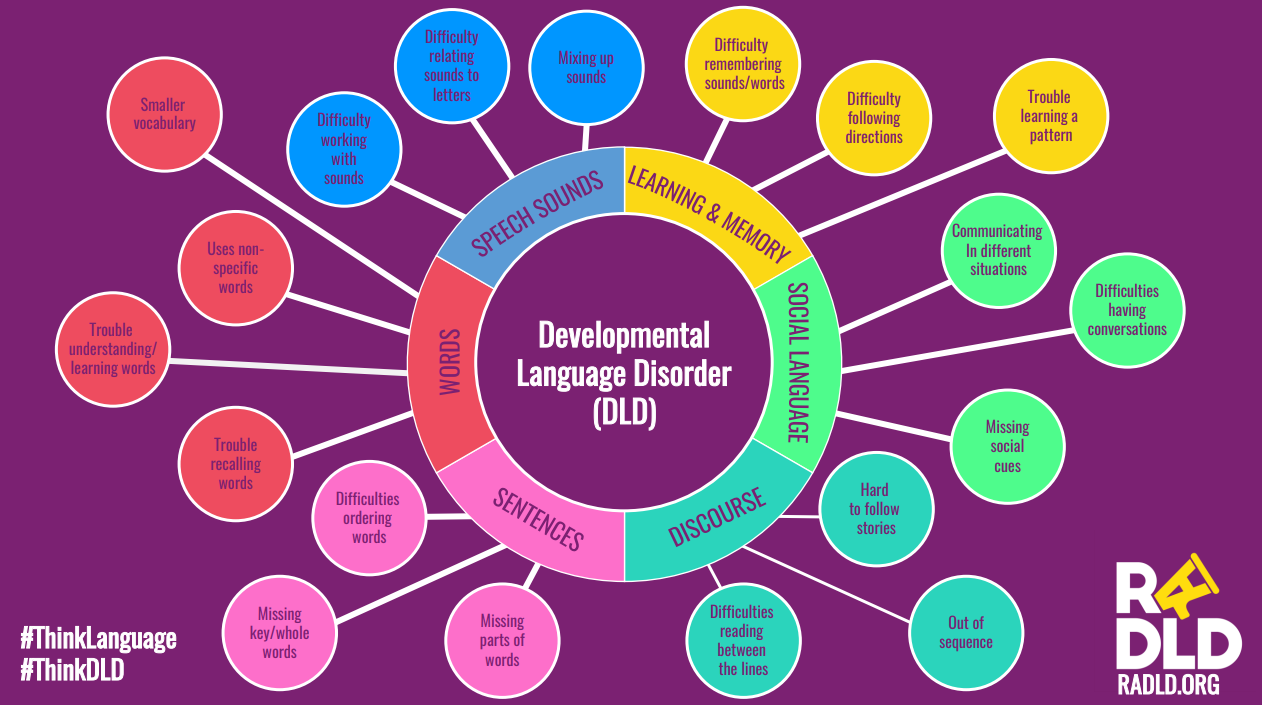
Supporting children or young people with DLD.
Tips to support your child or young person with DLD
- Remove distractions to help the child or young person listen.
• Use pictures, objects, actions and gestures to help them understand.
• Give the child or young person time to understand what was said and think about their answer. Wait up to 10 seconds before you repeat the instruction. Only say the instruction in a different way if you think the words were too hard.
• Give instructions in short sentences.
• Help key words stand out. Repeat them, say them slowly or write them down.
• If the child cannot think of a word, ask them to describe it, draw it, act it out or point to it.
• Ask the child or young person to tell you when they do not understand.
Developmental Language Disorder (DLD) school strategies information poster.
More links to videos and information about DLD
Think Language Think DLD video
Speech and Language UK - information on DLD
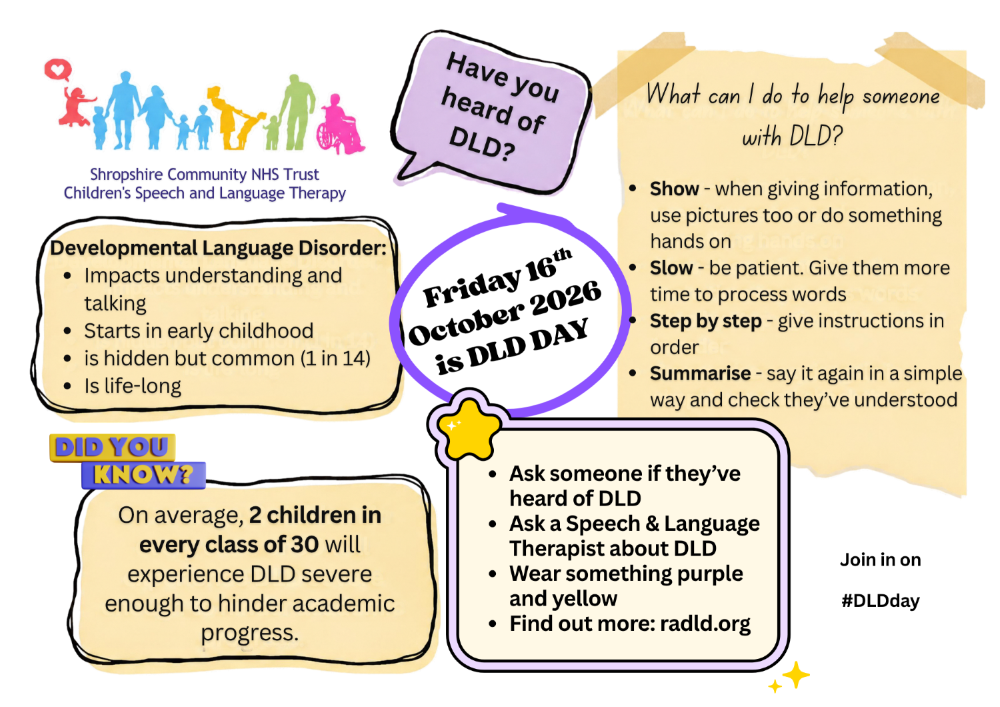
DLD awareness day 2026
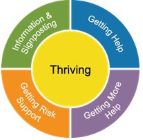
Link to the iThrive document which gives an overview to clinical staff, local authorities, parent & carer groups, third sector and voluntary organisations, schools, nurseries and parent & carers of current support, signposting, services and treatment available to children and young people who have language difficulties across Shropshire, Telford and Wrekin.